
Cork Arts Society Student of the Year Exhibition
Katelyn Stritch, Lucy Ahern, Quinn Sweeney, Ciara O’Neill
Main Gallery
25 February - 20 March 2027
Opening reception Thursday 25 February, 5.30-7.30pm
Artist talk 13 March, 12pm
Kindly sponsored by Roberts Advisory
Lavit Gallery is delighted to present Katelyn Stritch, Lucy Ahern, Quinn Sweeney and Ciara O’Neill as the co-recipients of the 2026 Cork Arts Society Student of the Year Award. This is an annual award given to one or more graduates of MTU Crawford College of Art & Design. In addition to an exhibition at Lavit Gallery the artist receives a cash prize kindly sponsored by Roberts Advisory, Cork.
The Student of the Year Award was initiated in 1967 by Cork Arts Society, now trading as Lavit Gallery, with sculptor John Burke as the first recipient and subsequent awardees including Maud Cotter, Eilis O’Connell and Vivienne Roche. Initially the award was solely a cash prize but it later evolved to include an exhibition once a gallery had been established. More recent recipients of the award include Helen Cantwell & Bernie Hennessy, Stephen Doyle, Orlagh O’Byrne & Padraic Barrett, Deirdre Frost, Andrea Newman, Lara Quinn and Danny Foley.
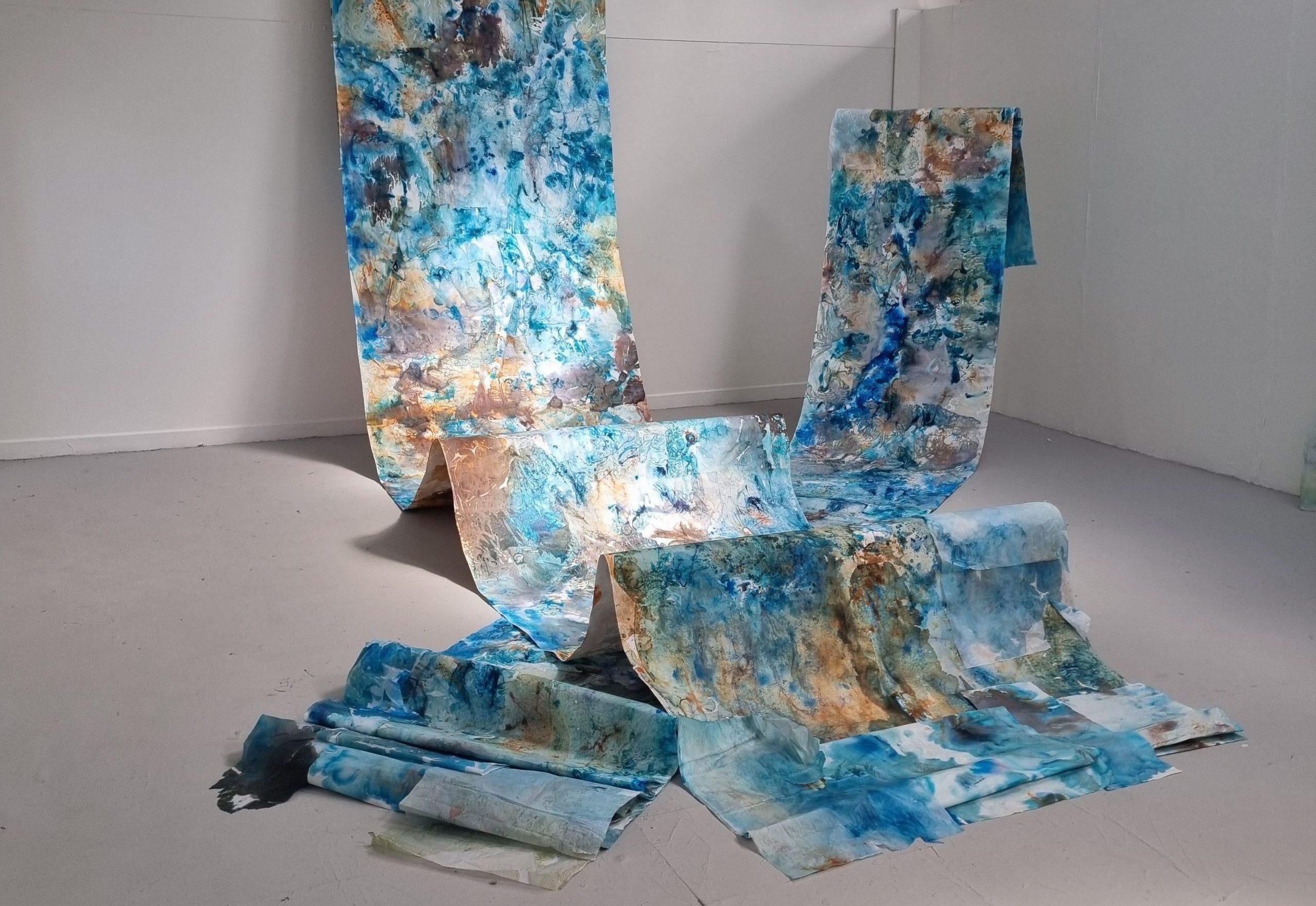
“Taking inspiration from my local beach of Ballyheigue bay in Co.Kerry, my art practice is a phenomenological ecological exploration of the Atlantic Ocean. Ballyheigue’s beach is my chosen site, and I investigate it through a processes called Deep-Mapping, which consists of walking, observing, listening to, collecting and researching. A fluid slow residency. Through this I investigate themes of environmental concerns, sedimentation, flooding, fluidity and waves. This practice employs the use of mixed media, inks, collage, mono screen-printing, cyanotype and installation techniques. In my studio I harness these explorations through the lens of a chance and process-based practice to create my work. I also harness the sea water from my site and bring it back into my studio, intuitively smearing it across the large sheets of paper, allowing the water to buckle and distort the paper while creating almost archipelagic pools of water, where then I go back in and add in all my other chosen media like sand and acrylic inks. I leave them to stain and place other materials from the site on top of the surface to mimic the beach and the waters natural process, layering rice, crepe or tissue paper on top to soak away the excess water after it has flooded the surface. I am left with a sediment of marks that have been buried into the paper. I look towards chance based intuitive artists for inspiration, like Tracy Hill with her hybrid spaces that understand the geological, informing the viewer of her own experience. Also Helen Frankenthaler for her fluid abstractions and Antonia Akien for her engagement with the landscape and materiality.” Katelyn Stritch, 2026
“My work consists of mainly drawing and painting. I work on paper exploring the female body through an imperfect lens. I focus on the nude through unconventional angles and points of view. The body is depicted through a colourful palette parallel to traditional nude drawings. Each body, drawn or painted, is done with a sense of vulnerability and passion. Creating layered compositions I hope to evoke a sense of introspection inviting the viewer into my world of self-reflection and healing. Through creating my art, I dive deep into the complexities of the relationship I have with my own body and self-image. Struggling to feel comfortable as a young woman in my own body, my art serves as a kind of personal catharsis leading to a journey of self-discovery and self-acceptance.” Lucy Ahern, 2026
“My visual art practice is multi-disciplinary and process-led and challenges traditional ideas of sound and how it is visually represented. Works surface through embodied mixed media drawing, photography (both digital and analogue) and sound. While recently working on Fabriano paper, explorations have also consisted of up-cycling and reconstructing, collage and establishing a developing practice with the paper making process. The audible world connects and informs but also invades and interferes, constantly revealing and concealing complex layers of relations in time and space. In a culture driven by data and machine intelligence, my practice explores the potential for knowledge and meaning in the unobserved sensory information through embodied drawing. To represent this, I use the paper surface as a state of potential transformation as like the body, it responds and remembers. Through adopting the characteristics of everyday sounds as they are experienced, work emerges from the unknown echoing the invisibility of the audible. Allowing fluid orientation, marks are deposited, responded to and changed, this expressing the bodily experience of interference, temporality and asymmetry. In a manner similar to sound which unfolds in time and space, visual conversations between layers narrate how this sensory information is not only lost but also revealed. Photography is employed throughout the process, stilling and flattening traces through time and exposure. This materially contrasts to the loud expression in drawing and working in the round.” Quinn Sweeney, 2026
“My practice is a reflection of works that trace my journey as an athlete, exploring the highs and lows of chasing success. As an endurance athlete I recreate my story through detailed drawings in pen, watercolour, and charcoal. I focus on anatomical forms that appear strained, distorted, or injured, capturing the physical and psychological toll that I’ve had to endure to continue, embodying vulnerability and resilience. My work embraces the setbacks and achievements that define progress, presenting success not as a fixed point but as a continuous process. Geography is central to my work. From collecting and analysing graphs and metrics recorded on my watch, I recreate routes, pace, elevation, and heart rate into visual compositions. These mappings preserve memories and capture endurance as both physical and emotional, where the body records each trail as a lasting imprint. I work on rice paper, Chinese paper, wallpaper rolls, and other delicate surfaces. Their delicacy mirrors both the athlete’s body and the unpredictable nature of the future, where winning is never guaranteed. Layering becomes a key process, symbolising the accumulation of training blocks and the gradual building of momentum over time. Just as endurance is developed through repetition and consistency, reflecting growth, persistence, and the fragile balance between pushing forward and breaking point. Muted, earthy tones mirror landscape, medical scans, heavy emotions, harsh weather conditions and memory, grounding the work in lived experience. The repetition of mark making mirrors training cycles, while fragmentation reflects memory’s instability. Ultimately, my work invites viewers to consider the delicate balance between strength and fragility, and the enduring impact of movement through time and place.” Ciara O’Neill, 2026